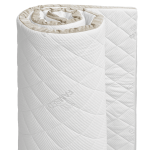

Natural latex or memory foam? We review the differences in comfort, temperature, chemistry and price – so you’re equipped to make the right mattress / topper choice.
Comfort
Latex: Moulds to the body but has an elastic quality and quickly regains its original shape. Latex provides progressive support – you don’t so much “sink into” it, but are free to turn throughout the night. Known for stable form over many years.
Memory foam: Excellent localised pressure relief, but can feel warm and “encapsulating”, as if you’re sinking into “a hole”, and over time can be more prone to permanent body impressions (indentations in the sleeping surface)
Temperature
Latex: Has a higher density, meaning it contains less air and therefore typically feels cool. The material is naturally breathable and is most often made with perforations that create a breathable mattress, also contributing to the cooling effect.
Memory foam: Has a high level of trapped air (insulation) and can often feel warm. The material’s “natural” breathability is low, contributing to a warmer sleeping environment.
Chemistry
Memory foam (PU-based): Made by reacting polyols with diisocyanates (typically MDI/TDI) and adding blowing agents, catalysts, surfactants and often adhesive to the layers. Can emit VOCs when new (“new mattress smell”) and in some cases cause skin irritation, among other things. The variations are significant: quality products are tested, but unfortunately there are still many memory foam products with both chemical flame retardants and/or strong adhesives. Consumer exposure is typically low with quality products, but potential odour/off-gassing is real – especially during the first days/weeks.
Natural latex: Vulcanised natural rubber with a rinsed core. A natural product with a simple manufacturing method involving very little / no unnatural chemistry.
Moisture / Mould / Hygiene
Memory foam: Dense structure + warmer microclimate and slightly moisture-absorbing → higher risk of moisture and mould issues.
Natural latex: Better airflow + hydrophobic material → lower risk, and furthermore a naturally antimicrobial material.
Price & industry logic
Latex: More expensive raw material, natural, heavier and more costly to handle → more often ends up in premium products.
Memory foam: Cheaper to produce and scale, easy to compress/package due to its low weight and large proportion of air. This makes it possible to offer affordable products – and in practice this often provides room for healthy margins, which is a significant reason for the material’s prevalence, along with skilful marketing.
Conclusion
Natural latex outperforms for many on support, temperature and long-term stability. Memory foam is preferred by some for its “hugging” comfort, but the trade-offs typically include more heat, greater moisture sensitivity and shorter form stability (especially at low density). The fact that memory foam dominates the market is largely because it makes it easy for manufacturers to create affordable products with room for large margins, combined with skilful marketing – not necessarily because the material is technically superior.
If you want the “hugging comfort” of memory foam: choose documented certifications, high density in the comfort layer, a breathable cover and a ventilated base, and you’ll get the best version of the material.