Soft vs. firm bed? – What is the right choice for co-sleeping?
When we talk about comfort in a bed, the first thing that comes into play is almost always personal preference: some feel “cosily wrapped” in a soft mattress, while others find it claustrophobic and want to lie more freely. It is very subjective.
But comfort is not just a feeling – it is also about how well the body is supported and whether you can turn freely during the night. For most adults, the best balance lies around a medium-firm to firm sleeping surface. Larger studies on adults with back pain have shown, for example, that medium-firm mattresses resulted in less pain and better function than very firm mattresses. The classic trial by Kovacs et al. in The Lancet found precisely that medium-firm produced better outcomes than very firm. [1][2]
This does not mean that everyone should sleep on the same firmness – weight, sleeping position and body type all play a role – but it does show that “the softer, the better” is not what the research points to, and particularly with regard to co-sleeping there are some clear guidelines for what is appropriate.
What does the science say – in brief?
- Research on adults: Medium-firm/firm support maintains the spine’s natural curves better than a soft comfort level – and often better than very hard as well. [1][2]
- For infants: The major health authorities recommend a firm, flat and continuous sleeping surface – not a soft, contouring or sloping base. This applies to, for example, the American Academy of Pediatrics (AAP), the CDC in the USA, the Lullaby Trust in the UK and the Danish Health Authority in Denmark. [3][4][5][6]
So there is a clear dividing line:
Adults can choose soft based on preference
Infants “must” sleep according to safety
Recommendations based on typical sleeping position?
For those who mostly sleep on their back and stomach – most experts recommend medium to firm
For those who predominantly sleep on their side – if you spend more than 90% of the time on your side, a soft comfort level could potentially be an advantage. But if you alternate between side, stomach and back, medium is most often recommended.
“The most natural”?
Historically, humans have slept on relatively firm surfaces: wool bases, straw mattresses, felt, blankets on cots or directly on the floor. Very soft, deep beds have only become common with modern materials (springs, foam, multi-layered toppers). So it is not the body that has changed – it is what we can produce.
Therefore, it is not surprising that:
- many people actually sleep more peacefully on slightly firmer surfaces, and
- modern safety recommendations for young children are closer to the “original”: firm, flat, without gaps.
Co-sleeping: why firm, large and continuous mattresses matter
Many families choose to co-sleep because it makes breastfeeding easier, increases closeness and makes the nights flow better. The authorities are also well aware that parents will end up co-sleeping – which is why recommendations today are often: “if you do it, do it safely”.
Across countries, the same points recur:
- Firm, flat mattress – the child must not sink in. [3][4][5]
- No gaps or holes – one large sleeping surface is safest, so the child cannot roll between mattresses or against the wall. Danish co-sleeping guidance states directly that the safest option is one large mattress, and that there should be as much space as in the child’s own bed. [6][7]
- The child should have their own thin duvet / sleeping bag and lie freely – not under the adult’s duvet and pillow layer. [5][6]
- Adults must be aware of risk factors (smoking, alcohol, medication, extreme tiredness). If these are present, co-sleeping in the same bed is advised against. [3]
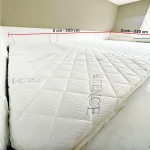
- Ample space – for example, Danish sources recommend a minimum of 140 cm if two adults and an infant are to lie together. [7] At FamBed we recommend 90 cm per adult and 60 cm per child if sleep is also to be comfortable.
What recurs across the AAP, the Lullaby Trust, the CDC and several European sources is that the danger of co-sleeping is not the fact itself that the child lies close to the parent – it is the soft, uneven or divided surfaces that can cause sinking or trapping. [3][5]
Why is FamBed a safe choice?
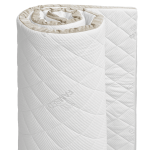
- 2 different comfort levels in one mattress (medium and firm) – The FamBed mattress is reversible with a medium and a firm side, which will suit most people’s preferences, except those who want a soft bed – but we do not offer this as it is inconsistent with the guidelines from experts and public authorities.
- Large, continuous sleeping surface – no gaps between two single beds that baby can roll into
- Option for firm/relatively firm construction – so the child does not sink in where the adult is lying
- Space for the child to have their own “zone” with their own duvet/sleeping bag, as the recommendations describe
This aligns very closely with the Danish perspective that if you choose co-sleeping, then one large, firm mattress is the safest option, because you avoid cracks and an overly soft sleeping surface. [6][7]
FamBed thus supports the elements in international recommendations that concern a firm, flat and continuous sleeping surface for co-sleeping.
References (for further reading)
- Kovacs FM et al. The Lancet (2003): Effect of firmness of mattress on chronic non-specific low-back pain. [1]
- Radwan A. et al. Sleep Health (2015): Effect of different mattress designs on promoting sleep quality, pain reduction, and spinal alignment in adults with or without back pain. [2]
- American Academy of Pediatrics (AAP) (2022): Sleep-Related Infant Deaths: Updated 2022 Recommendations for Reducing Infant Deaths in the Sleep Environment. [3]
- HealthyChildren.org (AAP) (2025): How to Keep Your Sleeping Baby Safe: AAP Policy Explained. [4]
- Centers for Disease Control and Prevention (CDC) (2024): Providing Care for Babies to Sleep Safely – “Use a firm, flat (not at an angle) sleep surface.” [5]
- The Lullaby Trust (UK): Co-sleeping advice and safer sleep overview. [5]
- Sundhedsstyrelsen (2022): Forebyg vuggedød – pjece til forældre (firm mattress, own duvet, ample space). [6]
- Sundhedsstyrelsen (professional material for health visitors): Forebyg vuggedød – og undgå skæv hovedfacon… (min. 140 cm, one large, firm mattress). [7]